
説明
HC-55 Agricultural Gearbox
Selection begins with the implement duty rather than the paint colour or housing outline. The gear train must transform the available input into the speed and torque required at the working element. The HC-55 entry is presented with its catalogue values, visible drawing and the integration questions that should be resolved before an order is released. Use the HC-55 drawing to close this point before production release.
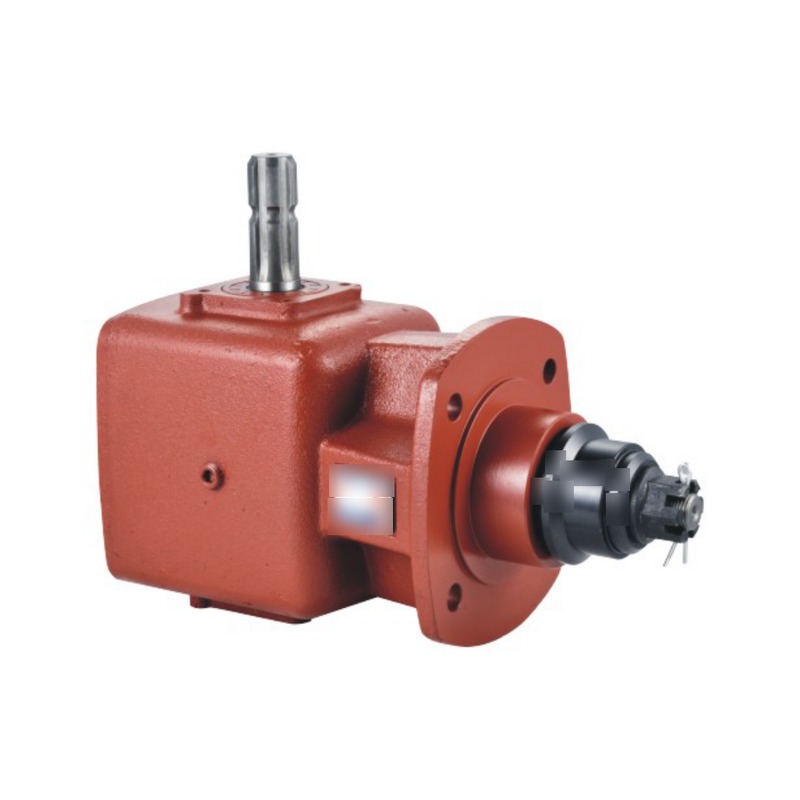
Catalogue Technical Data
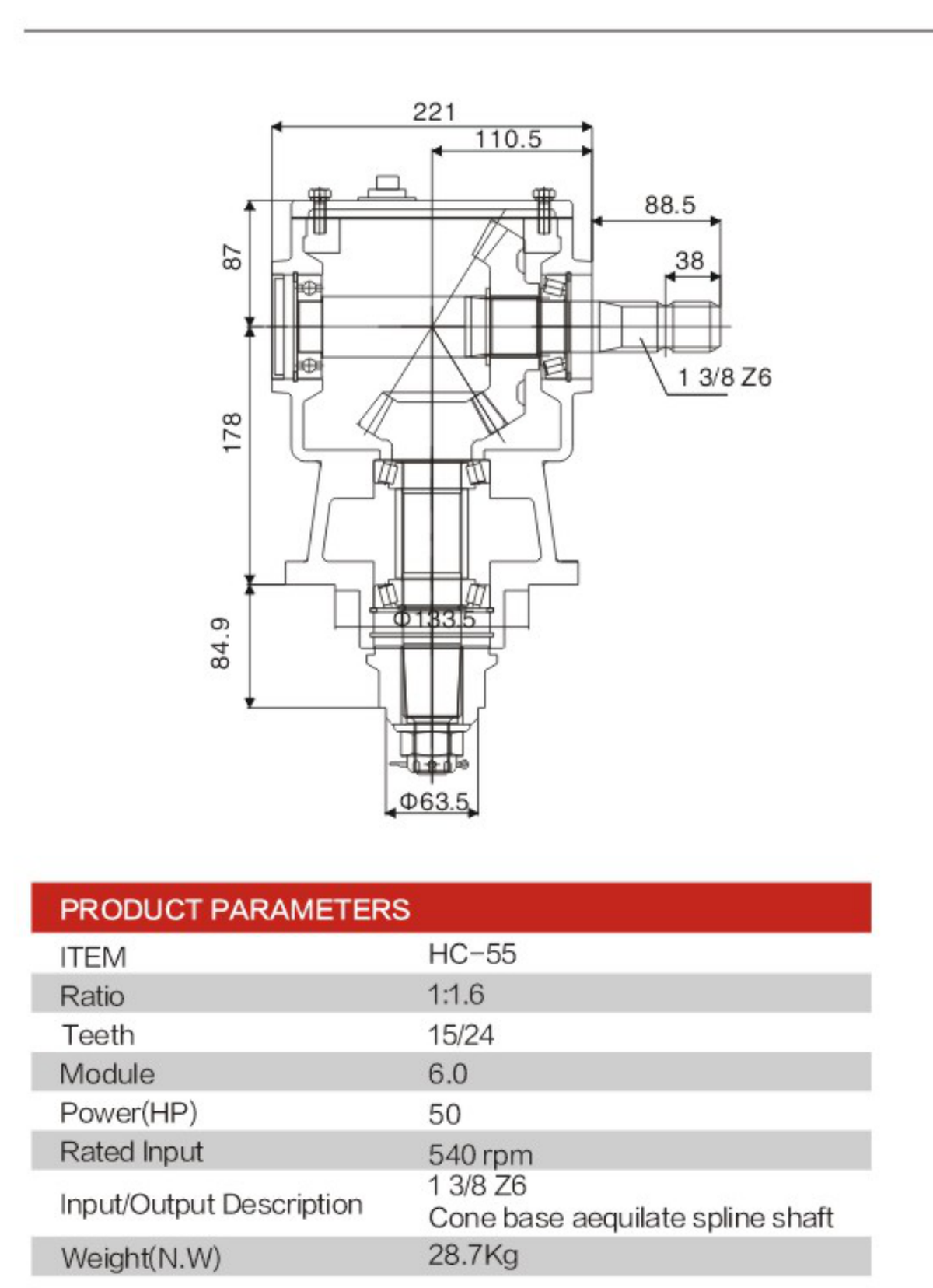
Source boundary for HC-55: values below are taken from page 4 of the supplied agricultural gearbox catalogue. Blank or unclear fields are shown as Not stated or marked for review. No external competitor rating has been assigned to this model.
| Parameter | Catalogue value |
|---|---|
| Model / family | HC-55 |
| Catalogue page | 4 |
| Ratio configuration | 1:1.6 |
| Teeth | 15/24 |
| Module | 6.0 |
| Catalogue power | 50 HP |
| Rated input | 540 rpm |
| Input / output description | 1 3/8 Z6 / equal-taper spline shaft |
| Net weight | 28.7 kg |
| Review status | reviewed |
| Source note | The source uses non-standard English for the output spline; confirm geometry from the order drawing. |
Dimension Drawing and Table Reading
The listed ratio set is 1:1.6. Confirm which convention is used on the approved drawing before calculating output speed; catalogues do not always state whether a ratio is written input-to-output or output-to-input. This check is configuration-specific to HC-55.
The teeth line identifies the tooth-count pair or sequence printed for the listed configuration. Tooth count and module help define pitch diameter and gear size, but they do not by themselves establish allowable torque. Tooth form, face width, material, heat treatment, bearing arrangement, case stiffness, lubricant, temperature and duty factor also govern capacity. The quotation record for HC-55 should preserve the source revision.
The input/output description should be matched to measured spline form, shaft diameter, key geometry, axial retention and usable engagement length. Similar-looking shafts are not automatically interchangeable. Send a marked drawing when replacing an existing unit, including rotation arrows and the view direction used to describe clockwise or counter-clockwise movement. Keep the HC-55 decision tied to the stated application and duty cycle.
What This Gearbox Must Do in the Implement
This family is associated with rotary cutters, finishing mowers, flail-related drives and vegetation-control equipment. The gearbox changes the relationship between input speed and output torque while redirecting the power path through bevel or related gearing. Selection should start with the resisting torque at the tool, not only tractor engine power. Estimate steady load, start-up inertia, shock events, duty duration and the time available for the housing to reject heat. For HC-55, the 1 3/8 Z6 / equal-taper spline shaft description still requires a controlled interface drawing.
A tractor rated at a high engine power does not mean every attached gearbox sees that full value continuously. At the same time, a modest average load can contain short peaks high enough to damage teeth, twist a shaft or brinell a bearing. For this family, blade inertia, imbalance and hidden obstacles can reverse or spike torque. The driveline needs a deliberate weak-link or torque-control strategy rather than relying on the gearbox to absorb every event. The selected HC-55 configuration should be traceable through inspection.
Check the implement speed requirement against the selected ratio. Excessive output speed increases blade-tip speed, bearing losses, oil churning and impact energy. Too little speed can overload the tool, reduce cut quality or encourage the operator to push the machine beyond its intended feed rate. Direction is equally important: reversing rotation can loosen threaded retainers, change oil distribution or drive a tool edge in the wrong sense. HC-55 is listed with 1:1.6; keep the ratio and tooth data together.
PTO Shaft and Companion Components
The matching system normally includes a guarded PTO shaft, overrunning clutch where needed, balanced blades, spindle bearings and a rigid deck. A PTO shaft must have enough telescoping overlap through the full hitch movement without bottoming at the shortest position. Universal-joint angles should remain within the shaft supplier’s limits, and yokes must be phased correctly unless a constant-velocity arrangement is specified. The page-4 data for HC-55 should not be separated from its model code.
ISO 500-1 covers general rear PTO specifications, safety requirements, master-shield dimensions and clearance zones for common tractor PTO types. ISO 500-3 covers manufacturing and location requirements for rear PTOs. Those tractor-side references do not replace the gearbox drawing. Confirm the actual spline, shaft shoulder, locking method, guard clearance and torque-limiter setting for the implement. Catalogue page 4 is the evidence anchor for HC-55.
Mounting, Alignment and Commissioning
- Compare every mounting face, pilot, bolt pattern and shaft centreline with the implement drawing. Do not pull a distorted frame into alignment with housing bolts.
- Check the input and output shaft runout, axial retention and engagement. A short spline engagement concentrates load and accelerates fretting.
- Verify rotation by hand before connecting tractor power. Confirm that the work element moves in the intended direction and that no guard, hose or structure interferes.
- Fill with the lubricant grade and quantity approved for the installation orientation. A level plug only works when it is located for that orientation.
- Run at low speed without load, inspect for leakage and abnormal noise, then add load in steps while monitoring housing temperature.
- Recheck mounting torque, oil level and shaft retention after the first controlled operating period.
When a long output tube, rotor shaft or auger is connected, the gearbox bearings should not be assumed to carry every external bending load. Add implement-side bearing support where the design requires it. Coupling misalignment and frame flex can create tooth-contact patterns that resemble a gear-quality problem even when the gears were manufactured correctly. This item affects the complete driveline around HC-55, not the housing alone.
Lubrication, Heat and Contamination Control
Agricultural duty combines dust, plant fibre, water and irregular operating schedules. The lubricant must maintain film strength at the tooth contact and bearing rollers while still flowing at start-up. Use the approved viscosity and oil type; mixing incompatible products can reduce additive performance or form deposits. Do not treat colour alone as a condition test. For HC-55, the stated 28.7 kg mass informs handling, not torque capacity.
The breather should equalize pressure without becoming a direct entry path for wash water or fine soil. A blocked breather can push oil through an otherwise serviceable seal. An exposed low-mounted breather can inhale water as the housing cools. Route or shield the breather where necessary, keep the seal running surface smooth, and remove crop wrapping before it polishes a groove into the shaft. For HC-55, document the result rather than relying on visual similarity.
Temperature must be interpreted against ambient conditions, speed and load. A new unit may run warmer during initial bedding, but a continuing rise, burned odour or rapid darkening warrants investigation. Common causes include overfilling, underfilling, wrong viscosity, misalignment, excessive bearing preload, overloaded gearing or a tool that is binding. Record temperature at a repeatable point rather than judging by touch. The 540 rpm entry must remain linked to the selected HC-55 gear set.
Failure Clues and Corrective Checks
| Symptom | Likely checks | Action before restart |
|---|---|---|
| Oil leakage at shaft | Breather blockage, shaft groove, seal lip, bearing play, overfill | Correct pressure and shaft condition; do not install a new seal over a damaged running surface. |
| Rhythmic noise | Damaged tooth, eccentric connection, incorrect backlash, debris | Drain and inspect oil, check magnetic plug, rotate by hand and inspect the gear set. |
| Rapid heating | Lubricant level, viscosity, alignment, preload, continuous overload | Remove load and determine the cause rather than operating until seizure. |
| Loose output hub | Key fit, spline wear, retaining hardware, external bending load | Replace damaged mating parts and restore the specified retention. |
| Repeated overload-device trip | Tool blockage, wrong limiter setting, incorrect ratio, excessive feed | Remove the operating cause; do not lock or weld the protection device. |
Regional Engineering Notes
For Colombia, equipment may move between humid lowlands, steep Andean terrain and abrasive dry zones. The purchase specification should name the working crop, altitude, daily operating hours, washing practice and the nearest source of replacement seals and bearings. A ratio that performs well in light pasture cutting may not be suitable for heavy residue, hillside operation or repeated transport starts. Use the HC-55 drawing to close this point before production release.
For the United States, guarding around farm field equipment and PTO-driven components must be reviewed against the applicable OSHA agricultural machinery requirements, while the implement manufacturer remains responsible for the complete machine. In Brazil, the machine-level assessment should account for NR-12 and its agricultural and forestry machinery provisions. For European markets, the technical file, risk assessment and declaration route should be checked for the applicable machinery law at the time the machine is placed on the market; the EU Machinery Regulation (EU) 2023/1230 applies from 20 January 2027. This check is configuration-specific to HC-55.
Across Southeast Asia, high humidity, frequent washing, mud and limited maintenance windows put emphasis on seals, breathers, corrosion protection and oil availability. European and North American projects often request clearer traceability for shaft drawings, guarding and validation records. None of these regional notes turns a catalogue gearbox into a certified machine. Compliance belongs to the completed implement and its documented configuration. The quotation record for HC-55 should preserve the source revision.
Information Needed for a Reliable Quotation
- Model code and clear photographs of every side
- Catalogue page and selected ratio
- Input speed and available power
- Required output speed and rotation direction
- Steady, start-up and peak torque estimates
- Application, crop, soil or material handled
- Daily duty hours and start-stop frequency
- Ambient temperature, washing and contamination
- Input spline and usable engagement length
- Output shaft, key, spline or flange dimensions
- Mounting hole pattern, pilot and centre height
- Guarding and PTO shaft arrangement
- Overload protection type and setting
- Lubricant, installation angle and breather position
Send the existing gearbox and implement drawings when available. Where a catalogue cell is marked for review, the quotation should not convert it into a guaranteed value. A controlled drawing, inspection plan and sample approval are the safer route for replacement or new-equipment integration. Keep the HC-55 decision tied to the stated application and duty cycle.
Technical Questions
Can the catalogue power value be used as continuous power?
Not without the manufacturer’s duty definition. A catalogue number may depend on input speed, service factor, operating time, temperature and shock level. The complete load cycle must be reviewed. For HC-55, the 1 3/8 Z6 / equal-taper spline shaft description still requires a controlled interface drawing.
Can a gearbox with the same ratio replace the existing unit?
Ratio is only one condition. Shaft geometry, centre distances, mounting stiffness, rotation, bearing loads, thermal capacity and lubrication orientation must also match. The selected HC-55 configuration should be traceable through inspection.
Does a 540 rpm listing guarantee compatibility with every tractor PTO?
No. Confirm PTO type, spline, guard clearance, shaft length, joint angle and the implement’s required speed. The tractor and implement form one driveline. HC-55 is listed with 1:1.6; keep the ratio and tooth data together.
What should be checked after a seal failure?
Inspect the breather, shaft surface, bearing play, oil level, contamination and alignment. Replacing only the seal can lead to a repeat leak. The page-4 data for HC-55 should not be separated from its model code.
Why is an approved drawing required?
The drawing fixes dimensions, tolerances, rotation, interfaces and configuration-specific details that a compressed catalogue table cannot show completely. Catalogue page 4 is the evidence anchor for HC-55.
Request A Quote
Provide the model, application, ratio, input speed, shaft drawings and operating conditions. The form is intentionally brief; technical files can be exchanged after the initial contact. Any substitution for HC-55 needs a fresh rotation and mounting check.